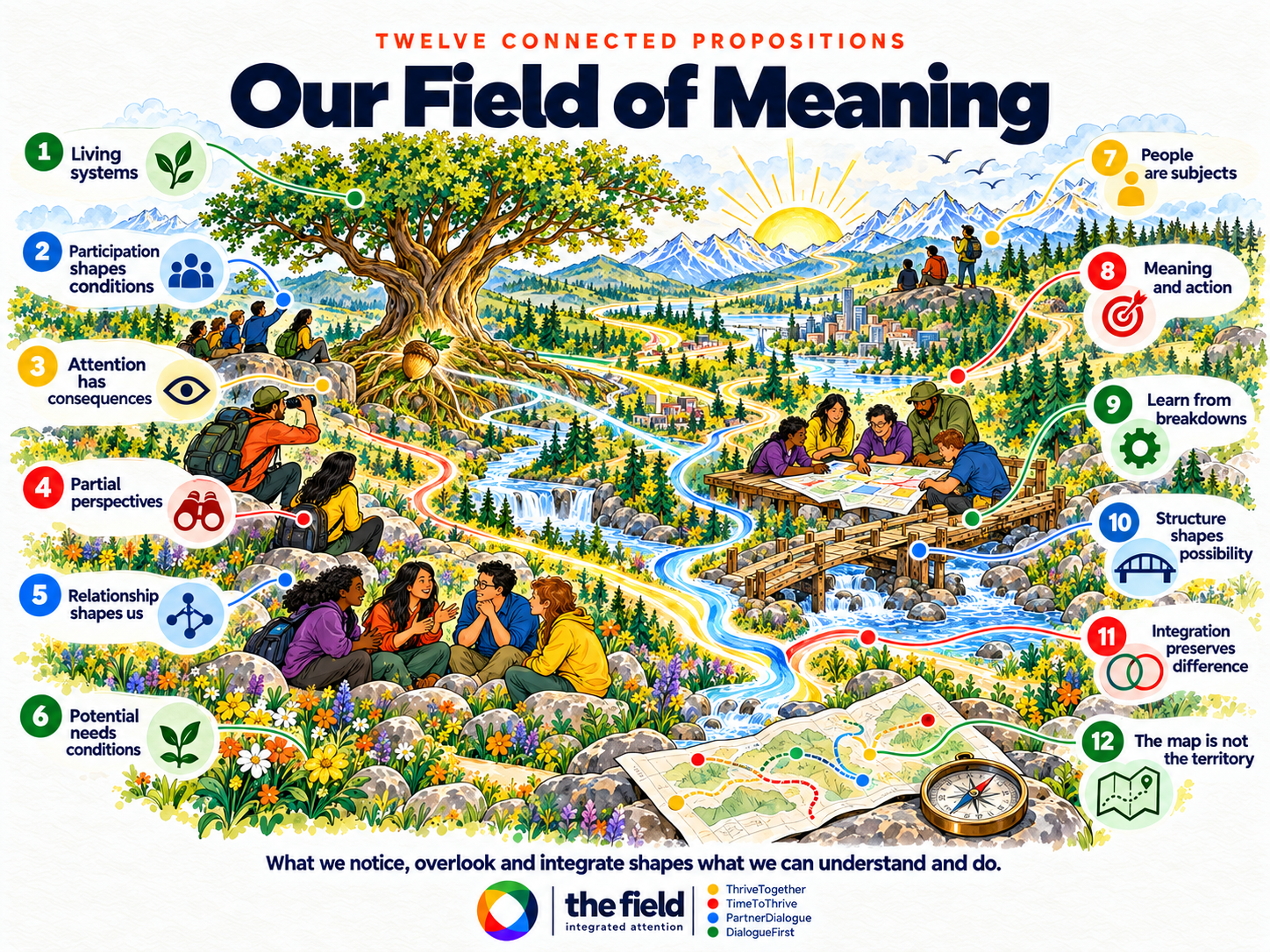
1. Human systems are living systems
Organisations and communities are living, complex adaptive systems shaped by relationships, histories, environments and continuing interaction.
2. We participate in what we observe
We do not stand outside the system. What we notice, name, reward, tolerate and do helps shape its conditions.
3. Attention is selective and consequential
Every act of attention reveals something and leaves something else outside the frame. The task is to widen and integrate attention when the situation requires it.
4. No single perspective contains the whole
Every participant holds a partial view. Dialogue allows different perspectives to become a resource for seeing more fully.
5. Relationship is constitutive, not incidental
Identity, meaning, capability and action are continually shaped in relationship. We are already participants in networks of mutual dependence.
6. Potential depends on conditions
Like an acorn becoming a tree, human potential unfolds through supportive conditions, relationships, resources and time.
7. People are subjects in process
People are legitimate others and participants in becoming, not objects, categories or instruments to be managed.
8. Meaning and action arise together
Understanding becomes useful through participation, while action produces new information that changes understanding.
9. Breakdowns can become generative
Failure, conflict and unkept commitments can reveal hidden assumptions and weak conditions when they are approached as information for learning.
10. Structure enables and constrains
Roles, incentives, authority, resources, technologies and operating rhythms shape what people are able to notice and do.
11. Integration does not mean sameness
Integration connects different perspectives, roles and methods while preserving the distinctions that allow each to contribute.
12. The map is not the territory
Models are provisional aids to attention and action. They should always be tested against lived experience.